AI search optimization (GEO) ChatGPT and Google
We check how AI assistants answer your customers' questions, and we work to get them to cite your website and name your brand. We measure visibility every day in our tool, Growth Mention.
A free 30-minute call, with no obligation


What is AI search optimization
Customers increasingly ask AI assistants instead of scrolling through search results. Whether your brand or a competitor's appears in the answer depends on your visibility in AI.
What it is
AI search optimization (GEO, or generative engine optimization) is the work that helps a brand appear in answers from AI assistants, as well as in AI Overviews and AI Mode in Google.
Citations and recommendations
AI may cite your website as a source or name your company among recommended firms. We work on both, because each one affects customer decisions in a different way.
How it differs from SEO
SEO is about your position in the list of results. GEO is about being present in an answer that AI assembles from several sources. The foundation is shared, so it works best to run both together.
What it aims for
We measure brand presence in answers to customer questions across a sample of hundreds of answers. We also track the traffic and queries that come from AI assistants.
- 1bnpeople use ChatGPT every week, including to search for and compare offersOpenAI, August 2026
- 32,7%EU residents aged 16–74 used generative AI tools in 2025Eurostat, December 2025
- +42%AI assistant traffic converts that much better than other traffic on US online storesAdobe, April 2026
What AI search optimization covers
Five areas that decide whether AI knows, cites and recommends your brand. We start with the one that needs the most work in your case.
Content that AI cites
We write answers to customer questions so that every section can be cited: with tables, comparisons and prices.
Brand mentions
We check which rankings, trade media and review sites feature your brand, and we work to keep it present there, because AI draws its recommendations from them.

Entities and company data
We tidy up the brand description across the web and structured data, so AI can clearly identify the company and its specialty.
Technical setup for AI bots
We make sure AI assistant and Google bots can access your site, that content is visible without JavaScript, and that you are visible in Bing.
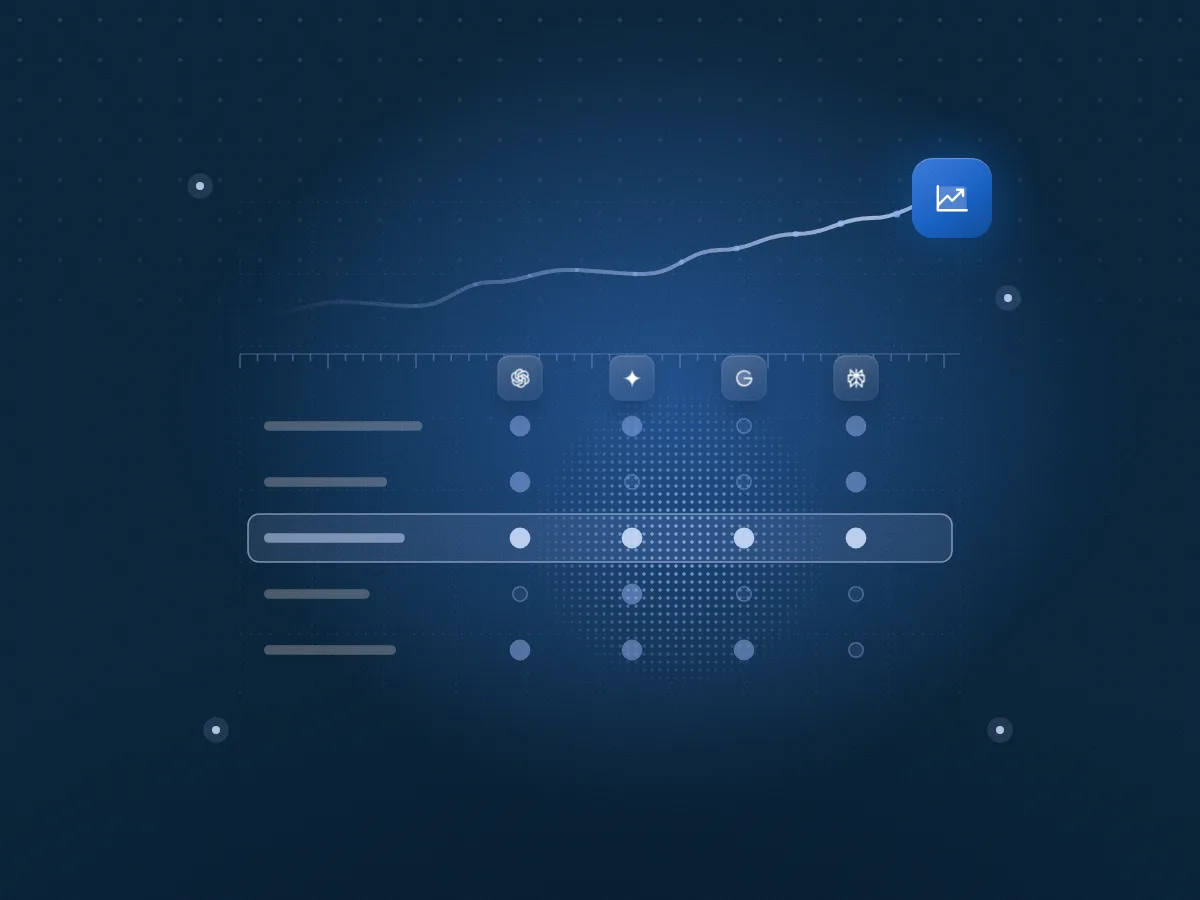
Answer monitoring
Daily tracking across five AI assistants: where your brand appears and where competitors do.
We'll check whether AI recommends your brand
We'll show which AI assistant answers mention your company and which mention competitors. Free of charge.
What companies come to us with
These are the problems companies bring to us most often, and how we solve them.
The AI assistant recommends competitors and never mentions us.
What we do about itWe check which sources AI draws recommendations from in your industry, and we build your brand's presence right there.
AI gives outdated or incorrect information about our company.
What we do about itWe tidy up company data on your website and across the web, so models have one consistent, up-to-date picture of your brand.
Our Google traffic has dropped since AI Overviews appeared.
What we do about itWe adapt content so that your site can be cited in an AI summary.
We don't know whether we are visible in AI at all.
What we do about itWe set a fixed list of customer questions and measure brand presence across five AI assistants every day.
AI search optimization in ChatGPT, Gemini and Perplexity
Each assistant draws on different sources, so different factors determine visibility in each one.
AI search optimization for ChatGPT
ChatGPT is one of the most popular AI assistants, and more and more people ask it to recommend a company, service or product. When a question needs up-to-date information, ChatGPT searches the web and links to its sources.
AI search optimization for ChatGPT rests on three areas: access for OpenAI's bots, visibility in the search engines the model uses, and the brand's presence in the rankings, articles and reviews that recommendations are based on.
A free 30-minute call, with no obligation
Where it gets its sources
- Search results, including from Bing
- Company rankings and lists
- Brand descriptions in media and review sites
What matters most
- Access for OAI-SearchBot
- Visibility in Bing
- A consistent brand description online
AI search optimization for AI Overviews and AI Mode
AI Overviews is an AI summary placed above Google's results, and AI Mode is conversational search. Both draw on Google search results, so a page that ranks high has a better chance of being cited.
AI Mode breaks a question down into several smaller queries. That's why the answer to the main phrase matters, as well as the answers to related questions: how much it costs, how it differs, who it is for. Every well-described section gives another chance to be cited.
A free 30-minute call, with no obligation
Where it gets its sources
- Google search results
- Pages ranking high for the query
- Product and company data in Google
What matters most
- Classic SEO
- Clear, verifiable sections
- Coverage of related questions
AI search optimization for Gemini
Gemini is Google's AI assistant, integrated with its search and Google services. It uses data Google already holds about companies, products and websites.
Visibility in Google, structured data and consistent company information across the web matter most here, because Gemini uses them to recognize the brand and its specialty.
A free 30-minute call, with no obligation
Where it gets its sources
- Google search and data
- Entities and the knowledge graph
- Expert content and reviews
What matters most
- Visibility in Google
- Structured data
- Clear company data
AI search optimization for Perplexity
Perplexity is an AI search engine that shows a list of sources with every answer. It readily uses current articles, reports and pages with numerical data.
For a page to appear in Perplexity, it must be accessible to PerplexityBot. Content should show a visible update date, figures and links to sources, because generic statements rarely make it into answers.
A free 30-minute call, with no obligation
Where it gets its sources
- Its own index and web search
- Current articles and reports
- Pages with data and sources
What matters most
- Access for PerplexityBot
- Update dates
- Figures and sources
AI search optimization for Copilot
Copilot is Microsoft's AI assistant, built into Windows, the Edge browser and Microsoft 365 apps. It searches for information using Bing.
Many companies don't check their visibility in Bing, yet it determines presence in Copilot and, in part, in ChatGPT too. Setting up Bing Webmaster Tools and quickly reporting changes are usually the first fixes we make.
A free 30-minute call, with no obligation
Where it gets its sources
- Bing search
- Pages ranking high in Bing
- Content from companies and industry sites
What matters most
- Bing Webmaster Tools
- Fast change reporting (IndexNow)
- Content in HTML
GEO and SEO: the differences
The foundation is shared: a site that can be read, valuable content and trust in the brand. What differs is where the results show up and how they are measured.
SEO
GEO (AI search optimization)
Goal
SEOa high position in the results list
GEObeing cited and recommended in an AI answer
Queries
SEOshort phrases typed into a search engine
GEOfull-sentence questions and conversation
Content
SEOpages matched to keywords
GEOsections that can be cited
Trust
SEOlinks from other sites
GEOlinks, brand mentions and reviews
Measurement
SEOrankings, traffic and conversions
GEOshare of answers, sources, traffic from AI
AI search optimization, step by step
We start with an audit, technical setup and brand data. Then we develop content and mentions, measure results and set the next priorities together with you.
- 01
AI visibility audit
- Questions your customers ask
- Brand presence across 5 assistants
- Sources AI cites
- 02
Technical setup and access
- AI bots and robots.txt
- Content visible without JavaScript
- Bing Webmaster Tools
- 03
Brand data
- Structured data
- Consistent company description online
- Profiles, directories, Wikidata
- 04
Content for questions
- Answers to customer questions
- Comparisons and tables
- Offer pages with prices and specs
- 05
Mentions and PR
- Rankings and lists
- Trade media and experts
- Customer reviews
- 06
Monitoring and reporting
- Visibility and share of voice
- AI traffic in GA4
- Plan of next steps
How much does GEO cost?
The price depends on whether the site already has solid SEO, on competition in the industry and on the number of questions monitored. We'll prepare a quote after a short analysis of your brand's visibility.
AI visibility audit
A one-off analysis covering customer questions, brand presence across five AI assistants, sources, competitors and a list of actions.
Best forcompanies that want to start with a diagnosis
SEO and AI visibility
We extend your site's Google optimization with content, data and mentions that matter to AI assistants, plus ongoing monitoring.
Best forcompanies that want to develop both channels
AI visibility monitoring
Access to Growth Mention: daily tracking of answers to customer questions across five AI assistants, comparison with competitors and reports.
Best forcompanies with their own SEO team
Want to know the cost for your company? We'll check your brand's visibility in AI and prepare a quote, free of charge.
Get a quoteOur own AI monitoring tool
 Growth Mention is our tool that checks your customers' questions across five AI assistants every day and saves every answer. Hover over a feature to see how it works:
- Visibility and share of voiceOur data shows that an AI assistant usually names only 3–5 companies in an answer. Every day we check your customers' questions across five assistants and show whether your brand appears, in what position, and how it compares with competitors.

- Sources and gaps in citationsIn 8 out of 10 answers, assistants link to the pages they rely on. We show which sites they use in your industry and for which questions they cite competitors.
- AI assistant searchesThese are the phrases assistants search for, so it pays to have an answer to them on your site.
- Brand description and sentimentWe show how AI describes your company: which traits it attributes to it, in what tone, and whether it gives wrong information that needs fixing at the source.

- AI bots and assistant trafficWe show which AI bots visit your site and for what purpose, as well as how much traffic and how many inquiries come from AI assistants.

Your brand in Growth Mention
We'll check a few of your customers' questions across five AI assistants and show the results against competitors. Free of charge.
Knowledge base on GEO
How AI answers are formed, where assistants get their sources, what to do so your brand is visible in them, and how to measure it.
Basics
Chapter 01 · BasicsWhat is AI search optimization?
Definition and differences between GEO, AEO, AIO and LLMO.
AI search optimization is the work that makes a brand, its site and its products appear in answers from AI assistants such as ChatGPT, Gemini, Perplexity and Copilot, and in AI summaries in Google (AI Overviews and AI Mode). The goal is for AI to cite your site as a source and recommend your company when someone asks about a solution in your industry.
Several names are used for the same activities:
- GEO (generative engine optimization) – optimization for generative search engines. The most commonly used term.
- AEO (answer engine optimization) – optimization for “answer engines”, meaning anything that gives a ready-made answer instead of a list of links.
- AIO and AI SEO – common names for optimization aimed at artificial intelligence.
- LLMO – optimization for large language models (LLMs).
Whatever the name, the goal is the same: for a model that assembles an answer from many sources to choose your content and mention your brand. AI search optimization does not replace classic SEO; it is built on top of it. Most assistants use search engines, and a site that is invisible in the results rarely makes it into an answer.
Chapter 02 · BasicsGEO and SEO – how do they differ?
A comparison table and why it pays to run both.
SEO and GEO share a foundation: a site that search engines can read, valuable content and trust in the brand. What differs is the result you are after and how it is measured.
| SEO | GEO (AI search optimization) | |
|---|---|---|
| Where the result shows | Results list in Google and Bing | An answer from ChatGPT, Gemini, Perplexity or AI Overviews |
| Unit | A page in a position | A passage cited in an answer and a brand mention |
| What it works on | Keywords typed into a search engine | Questions asked in full sentences |
| What matters most | Content, technical setup, links | The same, plus brand mentions and clear company data |
| How to measure | Rankings, traffic, conversions | Share of answers, position among recommendations, traffic from AI |
| Stability of results | Rankings change slowly | Answers differ with every query |
In practice, GEO is an extension of SEO. The best results come from running both together: SEO builds visibility in the results that AI draws on, and GEO makes sure the brand is described the way you want and recommended in answers. We write more about classic SEO on our SEO page.
Chapter 03 · BasicsHow AI assistants build answers
From question to answer with sources, step by step.
An AI assistant can answer in two ways: from knowledge gained during model training, or from pages it searches for in real time. For questions about products, companies and services, it increasingly does the latter.
- Understanding the question – the model works out what the user is looking for and often breaks the question down into several smaller queries.
- Finding sources – the queries go to a search engine (its own, Google or Bing), which returns a list of pages.
- Choosing passages – from the best-matching pages, the model picks individual paragraphs, tables and lists.
- Assembling the answer – the model writes the answer in its own words and adds links to its sources.
This pattern is called RAG (retrieval-augmented generation). It leads to the most important principle of AI search optimization: first you need to appear in the search results the model uses, and then you need passages on your site that are easy to extract and cite.
Training knowledge matters too. A brand that other sites write about often and consistently is “known” to the model and appears in answers more frequently, even without a search.
Chapter 04 · BasicsGEO glossary: key terms
GEO, AEO, RAG, query fan-out and other terms in one place.
AI search optimization comes with plenty of new names and abbreviations. Here are the most important ones in one place:
| Term | Meaning |
|---|---|
| GEO | Generative engine optimization – optimization for search engines and assistants that generate answers. |
| AEO | Answer engine optimization – optimization for systems that give a ready-made answer instead of a list of links. |
| AIO | A common name for AI optimization, sometimes also short for AI Overviews. |
| AI SEO | Another name for AI search optimization, used interchangeably with GEO. |
| LLM | Large language model, e.g. GPT, Gemini or Claude, which powers AI assistants. |
| LLMO | Optimization of content and brand for large language models. |
| AI Overviews | AI-generated summary that Google places above its search results. |
| AI Mode | Google search mode in the form of a conversation with AI. |
| RAG | Retrieval-augmented generation – the model searches for sources and writes the answer based on them. |
| Query fan-out | Splitting one question into several smaller searches before the answer is assembled. |
| Prompt | A question or instruction typed into an AI assistant. |
| Passage (chunk) | A piece of a page, e.g. a paragraph or table, that the model selects and cites. |
| Citation | Naming a page as a source of information in an AI answer. |
| Recommendation | Naming a brand as one worth choosing. |
| Share of voice | A brand's share of mentions in AI answers compared with competitors. |
| Sentiment | The tone in which AI describes a brand: positive, neutral or negative. |
| Hallucination | False information given by an AI model as if it were a fact. |
| Zero-click | A search that ends without a click on any site, because the answer was already right there. |
| Entity | A clearly recognizable object: a company, person, product or place. |
| llms.txt | A proposed file describing a site for language models; major search engines do not officially use it. |
We cover each of these terms in more detail in the following sections of this guide.
Google, ChatGPT and others
Chapter 05 · Google, ChatGPT and othersAI Overviews – where Google gets its sources
What Google says about the sources of AI summaries.
AI Overviews is an AI-generated summary that Google places above search results, with links to the pages it relies on. In Poland it appears for a growing share of queries, especially informational ones.
In its documentation for site owners, Google describes how content gets into AI features in search [1]. A few rules matter for search optimization:
- Sources come from the search index. To appear as a link in AI Overviews, a page must be indexed and meet Google's usual technical requirements – there are no separate requirements or special optimization [1]. Without good visibility in classic SEO, it is hard to get into a summary.
- Summaries link to sources. The answer is backed by links to the pages the information comes from [1]. Clear, verifiable passages that can be cited therefore matter.
- Not every query gets a summary. Google shows AI Overviews when it decides they add something beyond regular results [1].
The practical takeaway: pages that already rank in the results and have clear, verifiable passages answering the question are the ones that get into AI Overviews.
- “AI features and your website”, Google Search Central
Chapter 06 · Google, ChatGPT and othersAI Mode and query fan-out
How one question turns into many searches.
AI Mode is Google's conversational search mode: the user asks a question, gets a detailed answer with links and can ask follow-up questions. Google describes how AI Mode uses query fan-out: it splits a question into many sub-queries, searches for answers to each of them and assembles everything into one answer.
Example: the question “which coffee machine for a small office” may be split into queries about machine types, capacity, capsule costs, service and reviews. Each sub-query is a chance to cite a different page.
What follows from this
- One page can answer many sub-queries if it has separate, clearly described sections: who it is for, how much it costs, how it differs, how to choose.
- Coverage of the whole topic matters. A site that answers the next questions in a given field has more chances to be cited.
- Traffic from AI Mode is counted in Search Console together with Google search results, so part of the impact shows up in familiar reports.
Chapter 07 · Google, ChatGPT and othersChatGPT – how it chooses sources and brands
Search, Bing, OpenAI bots and rankings.
ChatGPT has built-in search. When a question needs up-to-date information, e.g. “which SEO agency in Warsaw” or “best city bike under PLN 3,000”, ChatGPT searches the web, using among other things Bing search results, and links to its sources.
- Visibility in Bing therefore matters. Many companies don't check their site in Bing Webmaster Tools at all.
- OpenAI bots need access to the site. OAI-SearchBot handles search in ChatGPT, and GPTBot collects data for training models. These are two separate decisions in the robots.txt file.
- Rankings and lists (“best…”, “top 10…”) are a frequent source for questions about recommending a company or product. Presence in credible lists feeds into recommendations.
- The brand description should be consistent everywhere: on your site, in company profiles, in directories and in media. Conflicting information increases the risk that the model gives false information.
ChatGPT also shows product cards with prices and links to stores. In e-commerce, product data, reviews and clear product descriptions matter.
Chapter 08 · Google, ChatGPT and othersGemini, Perplexity and Copilot
Where they get their sources and what to pay attention to.
Each assistant works a little differently, but the basics are shared: bot access, visibility in search engines and content that is easy to cite.
| Assistant | Where it gets its sources | What to watch |
|---|---|---|
| Gemini | Google search and data | Visibility in Google, company data across the Google ecosystem, consistent entities |
| Perplexity | Its own index and web search | Access for PerplexityBot, current content with dates, sources and data |
| Copilot | Bing search | Visibility in Bing, Bing Webmaster Tools, IndexNow |
| Claude | Web search when the feature is switched on | Access for Anthropic's bots, reliable sources |
We don't optimize separately for each model. We take care of the shared basics, then check in monitoring where the brand performs weakest, and look for the causes there.
AI search optimization in practice
Chapter 09 · AI search optimization in practiceContent that AI cites
How to write passages that can be cited.
An AI model rarely cites a whole page. It picks passages: a paragraph with a definition, a table row, an instruction step, a number. That is why content needs to be written so that each passage makes sense on its own.
- The answer first – the opening sentences of a section answer the question in the heading, and only then expand on the topic.
- Headings as questions – the kind customers actually ask: “how much does it cost…”, “how is it different from…”, “how to choose…”.
- Tables and lists – comparisons, specs, steps. Easy to extract and carry into an answer.
- Data – numbers, prices, deadlines, terms. Generic phrases like “we offer comprehensive solutions” have nothing to cite.
- Author and sources – a named expert, an update date and links to data increase credibility.
- Clear names – the full name of the brand, product and service, instead of “we”, “our product”, “this service”.
Content written entirely by AI, without expert knowledge or your own data, is rarely cited. The model already has general knowledge, and for answers it looks for what it doesn't know itself: current data, experience and offer details.
Chapter 10 · AI search optimization in practiceBrand mentions and digital PR
Citation versus recommendation, and where it pays to be present.
When someone asks AI to recommend a company, the model relies on what other sites write about companies. Your site says what you do, but it's rankings, articles, reviews and discussions that say whether it is worth choosing you.
Citation versus recommendation
These are two different things. Citation means AI named your site as a source of information. Recommendation means AI named your brand as the answer to “who to choose”. You can have many citations without recommendations, and the other way round.
Where it pays to be present
- industry rankings and lists, including company directories with reviews;
- trade and local media, interviews, expert commentary;
- review portals, e.g. Google, GoWork, Ceneo or ZnanyLekarz, depending on the industry;
- forums and communities where customers ask for recommendations;
- Wikipedia, if the brand meets its notability criteria.
Digital PR for AI differs from classic link building in that the mention and its context matter. An article that describes the brand as a leader in its category works even without a link.
Chapter 11 · AI search optimization in practiceEntities, Wikipedia and structured data
How to make AI clearly recognize the brand.
Search engines and AI models understand the world as entities: companies, people, products, places and the links between them. A brand that can be clearly recognized and connected with its industry is easier to recommend.
Google collects facts about people, companies and places in its Knowledge Graph and uses them to understand what pages are about [1]. Structured data helps with this, e.g. marking up an Organization with a logo, contact details and company profiles [2]. A site where the brand and its specialty are the main theme sends a clear signal.
What we do
- Structured data – Organization with logo, contact details and profiles (sameAs), Person for experts, Product, Service, FAQPage.
- Consistent company description – the same name, address, scope of services and description in profiles, directories and media.
- Wikidata and Wikipedia – if the brand has an entry there, the data must be current and consistent with your site.
- An “about us” page with facts – history, people, numbers, awards. It is a frequent source for questions like “who is…” and “what does… do”.
- Google, “Knowledge panels in Google”, Google Help
- “Organization structured data”, Google Search Central
Chapter 12 · AI search optimization in practiceAI bots, robots.txt and llms.txt
Which bots to let in and what llms.txt gives you.
For an AI assistant to cite your site, its bot must have access to it. Many companies block AI bots without realizing it, e.g. through firewall settings or services such as Cloudflare.
| Bot | Company | What it is for |
|---|---|---|
| OAI-SearchBot | OpenAI | Search in ChatGPT, i.e. citations and links in answers |
| ChatGPT-User | OpenAI | Visits to a page at the user's request in the chat |
| GPTBot | OpenAI | Collecting data to train models |
| Google-Extended | Permission to use content for training Gemini; does not affect search results | |
| PerplexityBot | Perplexity | Index and search in Perplexity |
| ClaudeBot | Anthropic | Collecting data for Claude models |
| Bingbot | Microsoft | Bing index, which Copilot uses |
Blocking a training bot (e.g. GPTBot) does not necessarily mean losing visibility in AI search, provided the search bot (OAI-SearchBot) has access. It is a business decision worth making deliberately.
llms.txt
llms.txt is a proposed standard: a short description of the site and a list of its most important pages for language models. Major search engines do not officially use it, so we treat it as an extra on top of AI search optimization.
Chapter 13 · AI search optimization in practiceTechnical setup for AI
JavaScript, speed, Bing and server logs.
AI bots are often simpler than Googlebot. Some of them don't run JavaScript, so content loaded by a script may be invisible to them.
- Content in HTML – key information, prices, descriptions and answers should be in the page code as soon as it loads.
- Speed and availability – a site that responds slowly or returns errors to bots is less likely to be used as a source.
- Bing Webmaster Tools and IndexNow – fast reporting of new and changed pages to Bing, which Copilot uses among others.
- Server logs – show which AI bots visit the site and which subpages they request.
- Up-to-date content – a visible update date and current prices, because assistants readily choose fresh sources.
Chapter 14 · AI search optimization in practiceAI search optimization for online stores
Products in AI and ChatGPT answers.
Customers ask AI what to buy: “which vacuum cleaner for a flat with a cat”, “best running shoes for asphalt”. Answers include product lists, comparisons and links to stores.
- Product data – Product and Offer structured data and the product feed in Google Merchant Center feed Google's product results, including in AI Mode.
- Product pages with data – specs in a table, use cases, who the product is for, comparison with similar models.
- Buying guides with a clear verdict: which model for whom and why.
- Customer reviews on your site and on external platforms, because AI readily summarizes what buyers say.
We write more about SEO for online stores on our e-commerce SEO page.
Chapter 15 · AI search optimization in practiceAI search optimization for B2B and service companies
Comparisons, case studies and rankings.
In B2B, the customer often starts by asking ChatGPT: “what fleet management systems are there”, “which agency will do an SEO audit”, “alternatives to [competitor]”. The list of companies they get becomes their list of contacts.
- Comparison and alternatives pages – fair comparisons with competitors are readily cited.
- Solution and industry pages – clearly describing who the offer is for and what problem it solves.
- Case studies with numbers – results the model can quote.
- Presence in industry rankings and directories with customer reviews.
- Named experts – media commentary and publications build recognition for people and the company.
Chapter 16 · AI search optimization in practiceThe most common AI search optimization mistakes
Eight mistakes that cause AI to skip the brand.
- Blocking AI bots through a firewall or robots.txt, without a deliberate decision.
- Content in JavaScript, invisible to simpler bots.
- Generalities instead of data – no prices, numbers, terms or comparisons.
- Conflicting company data in different places on the web, which leads AI to give false information.
- Ignoring Bing, which some assistants use.
- Mass AI-written content without expert knowledge, which adds nothing new.
- Measuring one query typed once into ChatGPT, instead of a fixed set of questions checked regularly.
- Dropping SEO and relying on GEO alone, even though AI draws on search results.
Measurement, costs and results
Chapter 17 · Measurement, costs and resultsHow to check a brand's visibility in AI
A quick test and how we do it systematically.
The simplest test: ask ChatGPT, Gemini and Perplexity the questions your customers ask, e.g. “which company to choose for…”, “best … in Poland”, “alternatives to…”, and check whether your brand appears, in what position and how it is described.
Such a test gives a first picture, but it has limits. AI answers vary with every query and depend on the account, location and conversation history. One question asked once says little.
How we do it in practice
- we set a fixed set of questions that customers ask at different stages of the purchase;
- we check them every day in ChatGPT, Gemini, Google AI Mode, Perplexity and Copilot, using our tool Growth Mention;
- we record whether the brand appears, in what position, in what context and which sources were cited;
- we compare results with competitors and track changes over time.
Chapter 18 · Measurement, costs and resultsMetrics: share of voice, position and sentiment
What to measure, given that AI answers vary.
Because AI answers vary, we measure trends across a large number of answers.
| Metric | What it shows |
|---|---|
| Visibility | The share of answers in which the brand appears |
| Share of voice | The brand's share of mentions compared with competitors |
| Average position | Where in the recommendation list the brand appears |
| Citations | How often the site is given as a source |
| Sentiment | Whether the brand is described positively, neutrally or negatively |
| Sources | Which sites AI uses for information about the industry and competitors |
The list of sources says the most. It shows which portals, rankings and articles shape the answers in your industry, that is, where it pays to be present.
Chapter 19 · Measurement, costs and resultsAI traffic in GA4 and Search Console
Where traffic from AI assistants shows up.
Some of the results of AI search optimization show up in site traffic. In GA4, visits from assistants appear as referral traffic from domains such as chatgpt.com, perplexity.ai, gemini.google.com or copilot.microsoft.com. It's worth creating a separate channel group for them, so that traffic and conversions from AI can be seen in one place.
Clicks from Google's AI Overviews and AI Mode are counted in the search data in Search Console, together with classic results.
Traffic is only part of the picture. Many AI answers don't end in a click: the customer reads the recommendation and types the brand name into Google, or arrives directly. That's why, alongside traffic from AI, we also watch growth in branded searches and direct visits.
Chapter 20 · Measurement, costs and resultsHow much does AI search optimization cost, and how long does it take?
Market price ranges and time to results.
Cost depends on whether the company already has solid SEO, on competition in the industry, on the number of questions to monitor and on the scope of work on content and mentions. On the market, AI search optimization offers usually start at around PLN 2k net per month, and with extensive PR and content work they are several times higher.
| Stage | Approximate timing | What happens |
|---|---|---|
| AI visibility audit | First few weeks | Customer questions, current visibility, sources, competitors |
| First changes | A few weeks | Bot access, content fixes, structured data |
| Growth in visibility | 3–6 months | New content and mentions start to appear in answers |
AI Overviews usually react faster, because they rely on current Google results. Changing how models describe a brand in answers drawn from training knowledge takes longer and depends on model updates.
Chapter 21 · Measurement, costs and resultsHow to choose an agency for AI search optimization
Questions worth asking before signing a contract.
AI search optimization is a new service, so it's easy to make promises that can't be kept. Before you sign a contract, ask:
- How do you measure visibility? A good answer is a fixed set of questions checked regularly across several assistants.
- Do you also do SEO? Without visibility in search engines, the results in AI are limited.
- Where do brand mentions come from? Buying mass low-quality publications is the same mistake as link farms.
- What will I get in the report? Visibility, share of voice, sources and actions for the next month.
- Do you guarantee a spot in ChatGPT? The honest answer is no. AI answers vary, and nobody fully controls them.
Companies that grow with us
-
 Stara Wieś Resort & OdnowaTourism
+1199%conversion value off-season
In season, conversion value rose by 160%, and off-season more than twelvefold. The resort now sells all year round.
View case study -
 UX solutions leaderB2B
1m USDcontract from a demand generation campaign
A demand generation campaign for a European market leader brought threefold growth and a USD 1m contract.
View case study -
 Coffee & SonsE-commerce
>1100%campaign ROAS in Q4
Campaigns built for the most important quarter of the year in specialty coffee sales.
View case study -
 Coffee & SonsE-commerce
>610%return on ad spend
Education about specialty coffee became the most effective sales channel for a family roastery.
View case study -
 Coffee & SonsE-commerce · SEO
+203%keywords in the Google TOP 10
A year of work on the visibility of a specialty coffee store in search results.
View case study -
 Coffee & SonsE-commerce
+180%budget YoY at ROAS >520%
Scaling ad spend without losing ROAS.
View case study -
 BLPaczkaB2B
VAT ID (NIP) validation that transformed a B2B campaign for a parcel shipping tool from the Base.com Group.
View case study -
 Moderno MebleE-commerce
How an upper mid-range furniture brand moved from dependence on marketplaces to brand-led growth.
View case study -
 Software houseIT / software house
120k USDrevenue in 2 months
An ABM strategy and a LinkedIn campaign opened foreign markets: 11 leads and 4 sales.
View case study
Questions about AI visibility
Answers to the questions we hear most often before starting work together. If your question isn't here, write to us.
Ask a questionWhat is AI search optimization?
These are actions that help a brand and its site appear in answers from AI assistants and in AI Overviews and AI Mode in Google. They are also called GEO, AEO or AI SEO.
Does AI search optimization replace SEO?
No. Most AI assistants draw on search engine results, so a site that is invisible in Google and Bing rarely makes it into an answer. GEO extends SEO, which is why it works best to run both together.
How can I check whether my company is visible in ChatGPT?
Ask ChatGPT the questions your customers ask, for example for a recommendation of a company in your industry. This test gives a first picture, but answers vary with each query. A reliable measurement needs a fixed set of questions repeated across several assistants.
How long does AI search optimization take?
We roll out the first changes, such as bot access and content fixes, at the start of the work. Changes in AI answers usually take several months and depend, among other things, on model updates. AI Overviews react faster, because they rely on current Google results.
How much does AI search optimization cost?
Cost depends on whether the site already has solid SEO, on competition and on the number of questions monitored. We prepare a quote after a short analysis of the brand's visibility. On the market, offers usually start at around PLN 2k net per month.
Can you guarantee a spot in ChatGPT?
No. AI answers vary, and nobody fully controls them. What we do is measure brand visibility on a fixed set of questions and report its share of answers.
Does AI search optimization cover AI Overviews?
Yes. AI Overviews and AI Mode draw on Google search results, so we work both on your rankings in the results and on passages that are easy to cite in a summary.
Do structured data help with visibility in AI?
They help clearly identify the company, products and experts. They are not enough on their own, but together with a consistent description of the brand online, they help AI give correct information.
Should I block AI bots?
It's a business decision. You can block a training bot such as GPTBot and keep your visibility in ChatGPT search, as long as the search bot OAI-SearchBot has access. We check whether your site is blocking bots unintentionally, e.g. through a firewall.
What should I do if AI gives false information about my company?
We find out which sources the model takes the wrong information from, and we correct it on your website, in company profiles, directories and media. Consistent, up-to-date data in many places may change the answers over time.
What content does AI cite most often?
Clear answers to questions, comparison tables, definitions, prices, data and step-by-step instructions. General descriptions of an offer without numbers or facts rarely make it into answers.
Does AI-written content hurt visibility in AI?
Using AI in itself does no harm, but content without expert knowledge or your own data is rarely cited, because it adds nothing new. We treat AI as a tool and base the content on knowledge and experience.
Does AI search optimization make sense for a small business?
Yes, especially in industries where customers ask AI for recommendations. A small company can often tidy up its data faster and win mentions in local or niche sources.
What is Growth Mention?
It is our own tool for monitoring brand visibility in AI. Every day it asks five AI assistants your customers' questions, saves the answers and shows visibility, share of voice, cited sources, the brand description and traffic from AI.
How do you measure results?
In Growth Mention we check a fixed set of questions across five AI assistants every day. We report visibility, share of voice, the brand's position in answers, cited sources and traffic from AI in GA4.
Do you also do Google SEO?
Yes, we usually run AI search optimization together with classic SEO. We write more about this on our SEO page.
How does AI search optimization for ChatGPT work?
When ChatGPT searches the web, it picks a few sources and answers based on them. AI search optimization for ChatGPT means making your site one of those sources: it answers customers' questions directly, is accessible to AI bots, and other credible sites also write about your brand.